Midway Securities Ltd. - Online Stock Broker: Trade shares in the Dhaka Stock Exchange (DSE) using our world class platform QuickTrade Pro App, all available online!
  • Home
  • Log In
  • Open a BO Account
    • ৳১৫০ বিও অ্যাকাউন্ট খুলুন
    • Open Joint BO Account
    • NRB BO Account
  • Link Account
  • Mobile App
    • QuickTrade Pro
  • Apply For IPO
  • Branches
  • Pricing
    • Pricing
    • প্রাইস
  • Deposit (টাকা জমা)
    • bKash, Nagad, Rocket
    • Credit Card (Deposit)
  • Withdraw (টাকা উত্তোলন)
  • FAQ
    • FAQ
    • বাংলা
    • Digital Booth FAQ
  • About Us
    • About Us
    • Our Services
    • Careers
    • Survey
    • Media
  • Foreign Investors
  • Contact Us
  • Form Download
  • Blog
  • Visual Research
  • G-Sec
  • Update Your Nominee

MIDWAY SECURITIES LTD.

DHAKA STOCK EXCHANGE LTD., TREC 142
শেয়ার বাজারে বিনিয়োগ সম্পর্কে এখানে জানুন। আমাদের রচনাগুলি আপনাকে নিরাপদে বিনিয়োগ করতে সহায়তা করবে।
বিও অ্যাকাউন্ট খুলুন
09609 100 142

Categories

All
ATB
Bonds
Dividend
IPO
Learn About Share Market
Margin Loan
Mobile App
Mutual Fund
Portfolio Transfer
Security
SME
বাংলা

Archives

December 2025
November 2025
October 2025
September 2025
August 2025
July 2025
June 2025
May 2025
January 2025
November 2024
September 2024
July 2024
June 2024
May 2024
April 2024
March 2024
February 2024
December 2023
November 2023
October 2023
September 2023
June 2023
May 2023
April 2023
March 2023
February 2023
January 2023
November 2022
August 2022
July 2022
June 2022
March 2022
January 2022
September 2021
July 2021
April 2021
September 2020
August 2020
June 2020
May 2020
March 2020
February 2020
January 2020
November 2019
July 2019
May 2019
March 2019
December 2018
November 2018
October 2018
September 2018
April 2018
March 2018
November 2017
September 2017
August 2017
July 2017
Bangladesh Bank's bond auction data explained

20/3/2024

0 Comments

 
Picture
Treasury bonds are instruments that the government issues to borrow. It is basically a debt to the government. It is being issued by the government while the auction is being conducted by Bangladesh Bank. Short term instruments (less than 1 year tenure) are called Treasury bills, and long-term instruments are called bonds (tenure more than a year).​

Reference: The Rahma Space
Bangladesh government issues bills of three maturities- 91 days, 182 days and 364 days. The auction for 91 days is held weekly, while for the other two, it is usually bi-weekly (depending on the government’s borrowing needs).

Bonds are for 2 years, 3 years, 5 years, 10 years, 15 years, and 20 years. Apart from the 3-year T-bond, the rest are all usually auctioned once a month. You can participate in Bond auctions through Midway Securities Ltd. 

The yield received on treasury instruments are usually called treasury rates. Anyone who invests in treasury bonds receives a particular rate of return. This is the yield of the bond. Suppose you hold a bond that has a yield of 7%. This means that your return from investing in this bond is going to be 7% (considering that you hold this bond till maturity).

There are two ways you get this return.

The first is through coupon payments. This is the fixed interest you will receive on a fixed time period basis (for Bangladesh Bank treasury bonds it is half-yearly) on the bond. The holder of the bond will therefore be receiving the interest amount on the bond.

Note: Bills are zero-coupon instruments. This means bills do not receive any coupon payments.

The second way is through the discrepancy between the price you bought the bond for and the face value of the bond. Face value is also known as par value. The price at which you are buying the bond for is known as the sale value.

The face value of the bond is the amount you will be receiving back from the government on the date of maturity. So, suppose, the face value of the 91-day T-bill you purchased is BDT100. You bought it for BDT90. When you are purchasing the bond, you will be giving the government BDT90. At the end of the 91-day period, the government will be giving you back BDT100. The difference between them, aka BDT10, is your return.​

Note: Since Bills do not have coupon payments, the yield is represented by the difference in the face vs sale value.

Note: Bonds have coupon payments, therefore, the yield is calculated with both the coupon rate and the price return amount. 

If you buy a bond at its face value, you are purchasing it at par value. If you buy at a price lower than its face value, you are buying it at a discount, and if you are buying it at a price above, you are buying it at a premium.
​Treasury rates are risk free rates

Treasury rates represent the risk-free rate of interest and affect the cost of borrowing for the country (for individuals and corporates). This in turn affects borrowing and spending appetites, which in turn affects production and the economic cycle.

Treasury instruments are basically risk free because the government is the one issuing and backing them up. The only time they won’t be paid back is if the government defaults on a domestic level, which is unlikely to happen (because the government can always ask the central bank to print money to pay back treasury bill/bondholders).

It is the safest instrument in a country in that sense. It is the amount that investors are willing to accept for zero risk, that is, it is the price of money.
What is the process?

When treasury bonds are being issued, this is a primary sale, aka it is being sold in the primary market. The buyer is buying the bond, and giving money to the government, who is the original issuer of the bond.

When a party already holds a bond and sells it to someone else, it is being sold on the secondary market. The government receives no money from the sale of the bond. The dealing is between the two parties (buyer and seller)

Let’s focus now on the primary market.

Treasury bonds are sold through auctions. Usually, only banks and FI’s participated in the auction. However, since 2023 general investors who hold BO accounts in Midway Securities Ltd. can purchase it as well.

How does the auction work?

As with all auctions, the buyer will place bids. The seller will decide which bids it wants to accept.

This is best illustrated with an example.

Let us say Bangladesh Bank is holding an auction for BDT1000 of 5-year bonds. (The amount that will be auctioned is based on the government’s needs during that period and borrowing appetite). For simplicity’s sake, let us assume that the coupon rate is zero (it is a zero-coupon bond). BDT1000 is the face value of the bond.

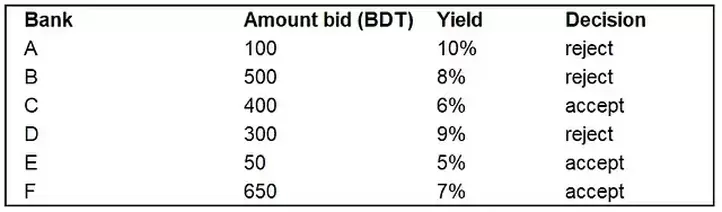
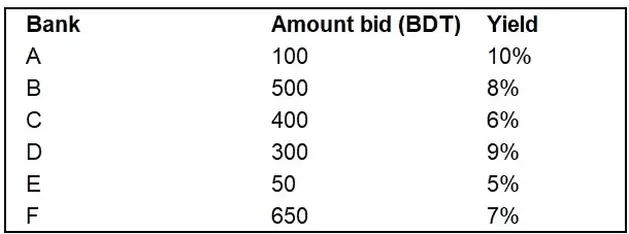
6 banks placed their bids for the bond. This is shown as the amount they are willing to lend out to the government; this represents the amount of treasury bonds they are willing to purchase, and the yield at which they are willing to buy it for.

Note: For clarification, the amount bid is based on the face value of the bank. Bank A bid for BDT100 taka worth of the bond means that at the end of the 5-year period, it will receive BDT100.
Picture
So, from here, we get a few key data points.

1. Number of bids received: 6 (6 banks placed bids)
​
2. Range of bids received: 5%-10%
a. Lowest yield bid: 5%
b. Highest yield bid: 10%

3. Total face value bid for: BDT 2350

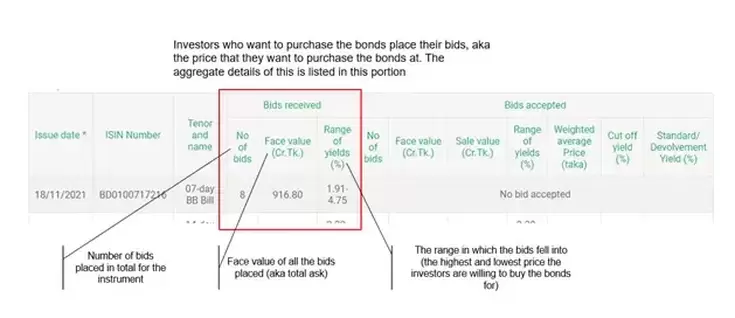
1 to 3 are the data we find in the bids received section of the treasury auctions data published by the Bangladesh Bank.

Note: Bank-wise/individual bid data is not released. Aggregate data is published.
Picture
​The next step is that the central bank will accept some bids and reject some of the other bids. This decision can depend on several factors, for example, i) the rate of the bids (I.e., price the banks are asking for), ii) borrowing need of the government (how much does the government need funds and are there any alternatives?).

Let’s go back to the previous example, with 6 banks placing their bids. The central bank (BB) has decided to reject bids above 7% and accept those below it. This means that BB accepts bank C, E and F’s bids, and rejects A, B and Ds. It ends up borrowing a total of 1000 (400+50+650) total from 3 banks (accepted 3 bids) in the range of 5%-7%.
Picture
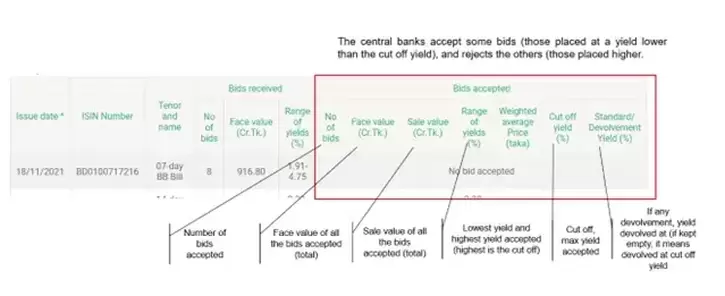
From here, we get a few key data points.

1. Number of bids that the central bank accepted (3 in this case)
2. Range of bids accepted
3. Cut off yield (maximum yield accept, in our example it is 7.00%)
4. Total amount of bonds SOLD by the central bank
5. FACE Value of the bonds SOLD (total)

The first 3 are quite self-explanatory, so let’s focus on the 4 and 5.

As we have already discussed above, the ‘face value’ of the bond is the amount the government will return at maturity of the bond (or bill). The total face value item in this case would therefore be the total amount the government would have to pay back to the 3 banks at maturity whose bids were accepted (so 1580).

However, that is not the amount that the government receives. The amount the government will receive is based on the ‘yield,’ or the rate. Assuming no coupon payments in this example, this means the face value will have to be discounted by the yield, to find the present value.

Why is this the case?

Let’s flip the perspective around to understand it better. Suppose you are Bank C. Your bid for BDT400 worth of the bond at a yield of 6% has been accepted. This means the bond you just purchased will give you 6% return p.a. There are two ways this can be done i) through coupons ii) through price vs. face value of the bond. Given that this is a zero-coupon bond, the only way is through the second one. So, you will buy the bond at a cheaper price, and at the end of the bond maturity, you will be returned the face value of the bond. This discrepancy between the two is your return.

In this case, BDT400 will be discounted for 5 years by 6%, and we get BDT299. Bank C will therefore purchase the bond for BDT299 and at the end of the 5-year period, will receive BDT400. This means that the government will receive BDT299 from bank C.

Note: Bangladesh Treasury Bonds have coupon payments every half yearly. This example is not indicative of the actual 5-yr T-bond. When a coupon payment is being paid, the return is derived from the coupon payment AND the price discrepancy. So, the price discrepancy would be much lower.
Picture
​Lastly, we have an item that is the weighted average price of the bids accepted. What this looks at is how much did the banks pay, on average (remember each bank received the rate it bid for, as long as it is at or below the cut-off yield) to purchase a bond with a face value of BDT100. This can be summarized as the sale value, over the face value, converted to a 100.
0 Comments


Leave a Reply.

    Author

    The Midway Team

    Categories

    All
    ATB
    Bonds
    Dividend
    IPO
    Learn About Share Market
    Margin Loan
    Mobile App
    Mutual Fund
    Portfolio Transfer
    Security
    SME
    বাংলা

    Archives

    December 2025
    November 2025
    October 2025
    September 2025
    August 2025
    July 2025
    June 2025
    May 2025
    January 2025
    November 2024
    September 2024
    July 2024
    June 2024
    May 2024
    April 2024
    March 2024
    February 2024
    December 2023
    November 2023
    October 2023
    September 2023
    June 2023
    May 2023
    April 2023
    March 2023
    February 2023
    January 2023
    November 2022
    August 2022
    July 2022
    June 2022
    March 2022
    January 2022
    September 2021
    July 2021
    April 2021
    September 2020
    August 2020
    June 2020
    May 2020
    March 2020
    February 2020
    January 2020
    November 2019
    July 2019
    May 2019
    March 2019
    December 2018
    November 2018
    October 2018
    September 2018
    April 2018
    March 2018
    November 2017
    September 2017
    August 2017
    July 2017
    RSS Feed

  • ​বিও অ্যাকাউন্ট খুলুন
  • Open BO Account
  • ​Link (লিংক) Account
  • IPO
  • Mobile App ​​
  • Pricing / প্রাইস
  • Withdraw (টাকা উত্তোলন)​
  • Deposit (টাকা জমা)​
  • Branches
  • FAQ
  • ​Contact Us​
  • Our Services
  • ​About Us
  • Blog
  • Market News
Dhaka Stock Exchange Building (Room No: 508)
9/F, Motijheel C/A, Dhaka 1000
Hotline: 09609 100 142
​[email protected]
Copyright Midway Securities Ltd. © 2024
Dhaka Stock Exchange Ltd.
Terms & Conditions
​Privacy Policy
  • Home
  • Log In
  • Open a BO Account
    • ৳১৫০ বিও অ্যাকাউন্ট খুলুন
    • Open Joint BO Account
    • NRB BO Account
  • Link Account
  • Mobile App
    • QuickTrade Pro
  • Apply For IPO
  • Branches
  • Pricing
    • Pricing
    • প্রাইস
  • Deposit (টাকা জমা)
    • bKash, Nagad, Rocket
    • Credit Card (Deposit)
  • Withdraw (টাকা উত্তোলন)
  • FAQ
    • FAQ
    • বাংলা
    • Digital Booth FAQ
  • About Us
    • About Us
    • Our Services
    • Careers
    • Survey
    • Media
  • Foreign Investors
  • Contact Us
  • Form Download
  • Blog
  • Visual Research
  • G-Sec
  • Update Your Nominee